
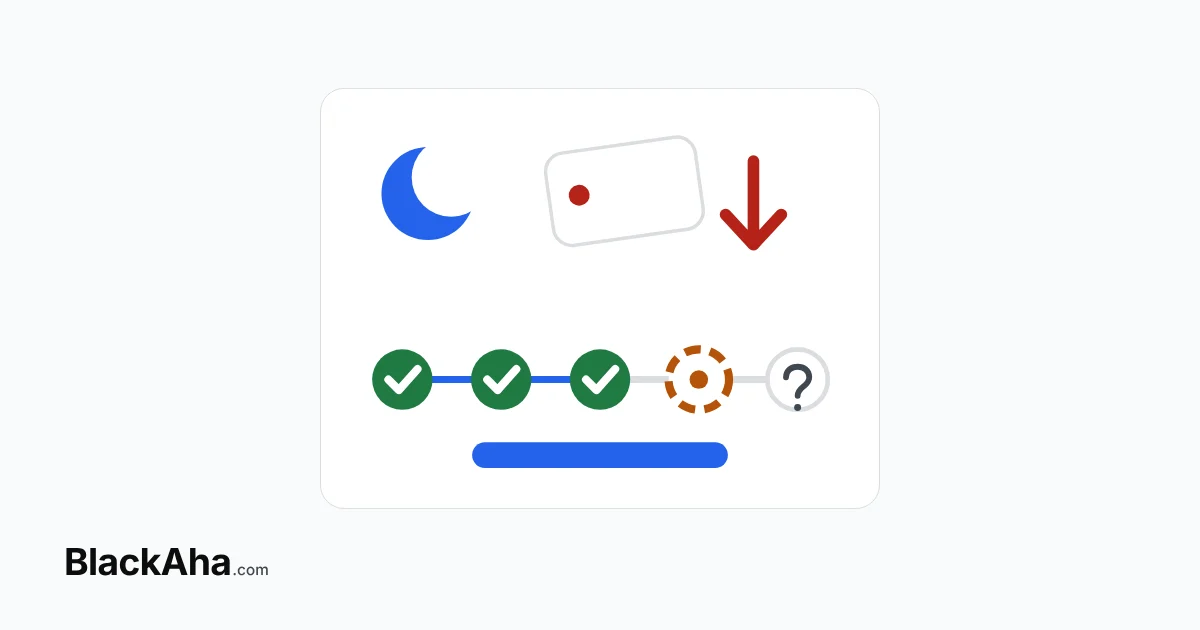
What to do when a competitor lowers prices: do not match on reflex. First check five things. Is the cut real? Can this rival reach your buyers? Are they advertising it? Is it one product or a pattern? What pricing style did you choose? Then hold, meet them part way, or answer with a rule that has a floor.
Should you match a competitor’s price cut right away?
Usually not. Picture a home appliance store. Overnight, a well-known rival cuts the price of its top-selling kettle, and the owner wants to match before lunch. A fast match can start a price war that neither side wanted. Decide the same day, after the checks.
What to do when a competitor lowers prices: five checks in order
Each check can end the process early.
1. Is the cut real?
A low price on a page is not always a price a buyer can pay. The item may be out of stock, the deal may cover one size only, or shipping may be extra. BlackAha Price Tracking records stock status next to every price. Variant Detection keeps a separate history for each size or colour.
Each trap has its own guide: out-of-stock bargains, shipping, bundles and member-only deals, cheaper on one size only and short flash discounts. Or sort any undercut with our checklist for spotting a fake price cut.
2. Can this rival reach your buyers?
A cut only costs you sales if your buyers see it. Domain Strength scores each competitor from 0 to 100 across five levels, from Very weak to Very strong, within your country market. A cut from a Very weak rival deserves a watch, not a response. For a reach-by-price-gap table, see our guide on whether a lower rival price will cost you sales.
3. Are they paying to show the new price?
Advertising turns a quiet cut into a loud one. Ad Tracking shows whether each competitor runs Google Ads or Meta Ads, with ad history. A strong rival that also advertises is the one to take seriously.
4. Is it one product or a pattern?
A deep cut on one best seller is often a loss leader: bait that sells other items at full price. A cut across a category is a change of position. Unlimited Price History and the category, brand and store reports show whether it happened before, and how widely. For more, see our guide to telling a temporary dip from a new normal.
5. What pricing style did you choose?
A store that wins on price has to stay close. A store that wins on service or fast delivery can hold a gap. Smart Price gives three recommendations per product, recalculated daily: Aggressive to win the sale, Balanced for margin and position, Premium for margin. If you are still on target after the cut, you may not need to move.
Which response fits your situation?
Put the answers together and read across.
| Is the cut real? | Rival’s reach | Pattern | Lean towards |
|---|---|---|---|
| No: out of stock, conditional or one variant | Any | Any | Hold. Note it and keep watching. |
| Yes | Very weak or Weak, no ads | Any | Hold. Check again in a few days. |
| Yes | Average or above, no ads | One product | Hold, or meet part way within your floor. |
| Yes | Strong, running ads | One product | Meet part way on that product only. Set a review date. |
| Yes | Strong, running ads | Many products | Review your position. Answer with a rule, not by hand. |
Your pricing style shifts each row one step: towards matching if you are Aggressive, towards holding if you are Premium.
How much does matching really cost?
The price gap looks small. The profit gap is not. In this illustrative example in USD, your kettle sells for $60 and costs $42, including fees and shipping. That is $18 profit per unit, or $2,160 a week on 120 sales. The rival drops to $50.
| Option | Price | Profit per unit | Weekly sales | Weekly profit |
|---|---|---|---|---|
| Match | $50 | $8 | 120 (you keep every sale) | $960 |
| Meet part way | $54 | $12 | 120 | $1,440 |
| Hold | $60 | $18 | 80 (you lose a third) | $1,440 |
Holding and losing a third of your sales earns the same as meeting part way. Both earn 50% more than a full match. To stand still after matching, you would need 270 sales a week, 2.25 times your volume. Quick test: your profit per unit now ÷ your profit per unit after matching = how many times sales must grow.
How do you answer a cut without losing your margin?
Set your limits first. A price floor is the lowest price you accept for a product. Without one, a rule follows the cheapest rival all the way down.
In BlackAha Dynamic Pricing, guardrails are always applied last. Take the rule example shown in the app: if the rival is the lowest, set your price to the lowest minus 2%. With a floor of $48 and the rival at $50, you land at $49. If the rival drops to $45, the rule asks for $44.10, and the guardrail keeps you at $48. Preview shows the final price before anything changes.
For one product, see answering a rival’s cut on a single item. For standing rules, see our guide to writing match, hold and undercut rules. New prices reach WooCommerce, Magento and OpenCart stores through the store integration.
How BlackAha helps
BlackAha.com tracks competitor prices for online stores and helps you set your own. Every check above maps to a signal in the app, and Price Change Alerts tell you when a rival moves. Dynamic Pricing then applies your rule with guardrails.
Key takeaways
- Do not match on reflex. Decide the same day, after five checks.
- A cut you cannot buy at (out of stock, one variant, extra conditions) needs no answer.
- Weigh the rival before the price: Domain Strength and ad activity tell you whether buyers will see the cut.
- Small price gaps hide large profit gaps. In the illustrative example, a $10 cut takes more than half the profit per unit.
- If you respond, use a rule with a floor so a second cut cannot drag you below it.
Frequently asked questions
How fast should I react when a competitor lowers prices?
Decide the same day, but not in the first hour. Check whether the cut is real, how strong the rival is, whether they run ads and whether it is one product or many. With tracked data, this takes minutes.
Should I always match a competitor’s lower price?
No. Matching can cost far more profit than the sales it saves. In the illustrative example, holding and losing a third of sales earned the same as meeting part way and 50% more than a full match.
How can I tell if a price cut is just bait?
Look at the rival’s other products and its price history. A deep cut on one best seller, with the rest of the range unchanged, is often a loss leader. A cut across a category is a change of position.
What stops an automatic rule from starting a price war?
A floor. In BlackAha Dynamic Pricing, guardrails are applied after every rule, so the price never goes below the limit you set, even if the rival keeps cutting.
Next time a rival cuts, start with the rival. Check its Domain Strength and ad status, and set your floor before the next move. You can try BlackAha on your own catalogue.

 English
 ไทย
 Tiếng Việt
 한국어
 日本語
 简体中文
 Français
 Deutsch
 Русский
 Italiano
 Polski
 Español