










In the rapidly evolving landscape of online business, understanding the Top Product Pricing Strategies for Ecommerce (2026) is crucial for any entrepreneur aimed at maximizing profitability while maintaining a competitive edge in the market. Pricing is not merely a number; it encapsulates a strategy that influences consumer behavior, brand perception, and overall business viability.
Recognizing the Importance of Pricing Strategies
Determining the right pricing strategy is more than an exercise in number crunching. It's about understanding your value proposition, customer expectations, and market dynamics. Effective pricing strategies are paramount to establishing the brand image and driving sales, acting as a compass that guides various business decisions. A clearly defined strategy enables entrepreneurs to navigate competitive pressures while ensuring they remain aligned with their broader business objectives.
Establishing an effective pricing framework begins with a granular analysis of fundamental factors that influence pricing. So, how does one approach the pricing conundrum effectively?
Understanding Your Costs: The Foundation of Pricing Strategy
Before you can even think about pricing your product, comprehending the costs involved in bringing your product to market is essential. This aspect is akin to laying down the foundation of a house; without it, nothing else can stand. The total cost consists of the cost of goods sold (COGS), which includes raw materials, manufacturing expenses, labor, and additional overheads.
To arrive at a sound pricing strategy, you need to ask the following questions:
- How much does it cost to produce each item of your product?
- Are there any additional costs associated with packaging, shipping, or marketing?
Understanding these aspects equips you to calculate the minimum selling price and to gauge how much of a profit margin you can realistically strive for.
Effectively tracking these costs will allow you to develop a pricing strategy that not only covers expenses but also ensures profitability for sustainable growth. This analysis will inform the subsequent steps in deciding a pricing strategy that aligns with both your business objectives and consumer perceptions.
Identifying Your Target Customer: The Key to Value Proposition
Once you have a handle on your costs, the next step lies in identifying your target customers. Who are they? What do they value? Understanding your customers' demographics, preferences, and behavioral patterns will help you gauge their willingness to pay. Discretionary income plays a pivotal role here; it indicates how much a consumer can afford to spend on non-essential items.
Moreover, consider the psychological aspects of buying behavior and price sensitivity. Some customers are willing to pay a premium for perceived value, while others gravitate towards budget-friendly options. This information will be instrumental in creating a value proposition that resonates with your target audience.
Understanding your customer also allows for personalized marketing strategies that can positively impact pricing. Tailor your messages to highlight the unique value your product offers, thus fostering loyalty and encouraging repeat business.
The Competitive Landscape: Gauging Market Expectations
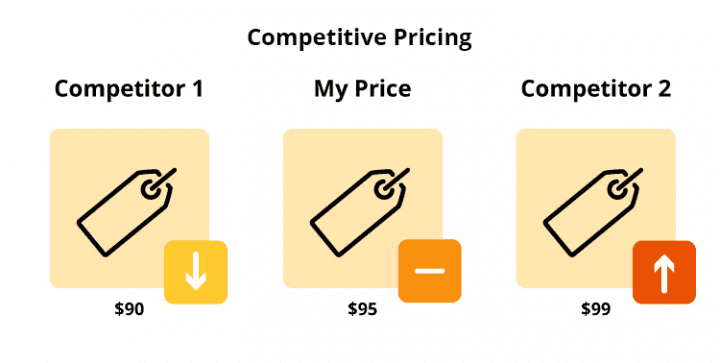
The competitive landscape is another critical factor in defining your pricing strategy. Research your competitors’ pricing and identify how your product stacks against theirs. Competitive pricing is prevalent in industries with similar products, where price becomes a major differentiator. By effectively pricing your products against competitors, you can position your offering to attract potential customers.
Implementing a competitive pricing strategy involves setting prices lower than your competitors while still recognizing the value you bring. Leveraging your unique selling proposition (USP) in your marketing materials will help clarify why customers should choose you over your competitors.
Additionally, competitors may frequently alter their pricing based on market trends and consumer behavior, requiring businesses consistently to monitor their pricing strategies. Flexibility in adjusting prices based on market dynamics can facilitate quicker adaptations, helping businesses to maintain relevancy and consumer interest.
Various Pricing Strategies: Decoding the Options
After establishing a foundation for pricing, the next step is to explore various pricing strategies. Each strategy offers a unique approach resulting in distinct outcomes, making it essential to choose one that aligns with your business model, target market, and broader objectives.
Value-Based Pricing: Capturing Perceived Worth
Value-based pricing is a compelling approach that takes into account how much a consumer perceives a product's value. Unlike cost-plus pricing methods, which simply add a markup to production costs, value-based pricing focuses on customer perception and willingness to pay. This strategy is especially effective for businesses offering unique products that solve specific problems or reflect niche needs.
To implement value-based pricing, businesses must:
- Understand their customers’ needs and desires.
- Conduct market research and engage in consumer feedback.
By doing so, businesses can position their products as true solutions to customer pains, thus securing higher prices. A compelling narrative and well-structured marketing strategies can effectively showcase the unique value your product provides, ensuring robust customer engagement.
This strategy also allows for price variations based on customer segmentation. Within a single market, some segments may perceive greater value in specific features, allowing businesses to tailor prices for maximum profitability.
Competitive Pricing: Staying Ahead in the Game
As previously mentioned, competitive pricing revolves around analyzing competitor prices to carve out a market position. It’s not merely about lowering your price; rather, it’s about strategically positioning your pricing above, below, or equal to competitors, depending on the value proposition you offer.
To adopt a competitive pricing strategy, it is essential to conduct regular market analysis and research. You should constantly evaluate pricing landscapes and make informed adjustments based on competitor actions and market conditions.
This strategy enables businesses to remain relevant, especially in saturated industries where price is often the sole differentiator. The introduction of promotions, bundles, or discounts can also complement competitive pricing, incentivizing consumers to take action while boosting overall sales numbers.
Economy Pricing: The Power of Volume Sales
Economy pricing is a strategy defined by setting lower product prices to achieve profitability through high sales volumes. This strategy is particularly effective for essential goods where customers are less likely to remain loyal to a brand and may make decisions based on price alone.
While utilizing this strategy, it is crucial to maintain efficient production processes and cost management to retain profitability despite lower prices. Proper supply chain management combined with targeted marketing costs will help ensure consistent inventory turnover, making up for profit margins through increased sales volume.
Although this strategy can be beneficial for initial entry into the market, it may require significant marketing efforts and branding strategies for long-term viability. Establishing a strong brand presence with quality products is vital to transforming the “no-name” buyer into loyal customers over time.
Embracing Innovative Approaches: Dynamic Pricing and More
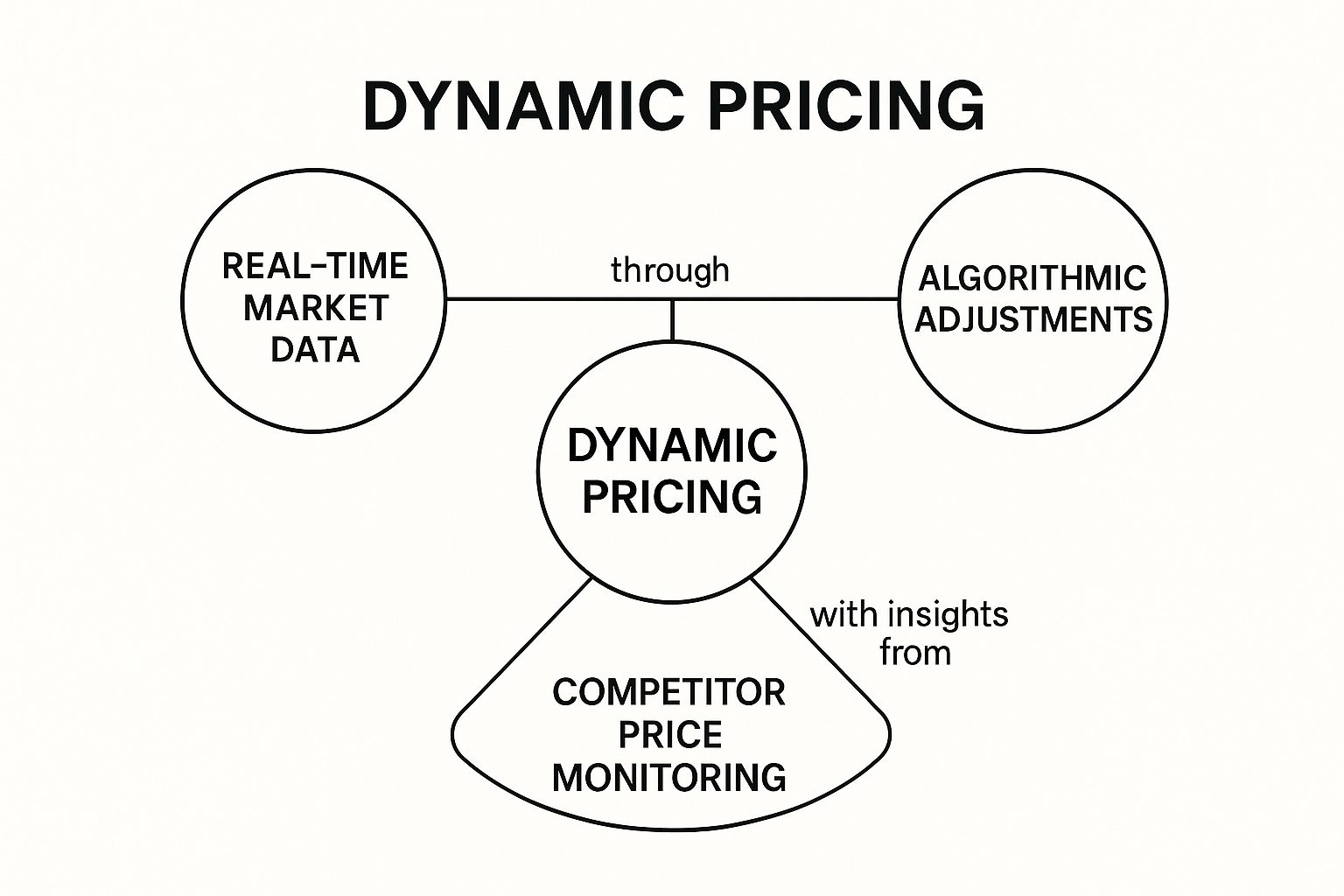
With the evolution of technology, businesses are finding new avenues to optimize pricing through innovative strategies. Dynamic pricing, discounts, and loss-leader pricing are examples of how modern digital tools can improve pricing strategies.
Dynamic Pricing: Automation at Its Finest
Dynamic pricing utilizes algorithms and data analytics to adjust prices in real-time based on market demand, supply, and other variables. With the aid of machine learning, businesses can automatically implement pricing updates that reflect current market conditions, enabling optimal pricing without constant manual intervention.
Key benefits of dynamic pricing include:
- Maximizing profit potential by capturing high-demand moments when consumers are willing to pay more.
- Reducing prices automatically during slow sales periods, attracting more customers.
While the benefits of dynamic pricing are clear, it requires ongoing data analysis and predictive modeling for maximum effectiveness. Regularly monitoring pricing performance helps to refine approaches and maximize profitability.
Discount Pricing: Leveraging Promotions and Offers
Discount pricing is another highly effective approach in the ecommerce setting. By offering sales, seasonal discounts, and promotional pricing, businesses can create urgency among consumers to drive immediate sales. This strategy is particularly valuable when clearing out inventory or attracting new customers who may be price-sensitive.
While discount pricing offers clear advantages, it should be part of a broader marketing approach. Maintaining brand integrity, focusing on product value, and measuring the impact of discounts on consumer perceptions will ensure businesses don’t undermine their worth or profitability.
Nevertheless, successful implementation of discount pricing may lead to increased foot traffic, brand recognition, and consumer trust, building the foundation for sustained success in the marketplace.
Loss-Leader Pricing: Attracting Customers with Strategic Bundles
Loss-leader pricing involves offering select products at a loss to drive volume sales, subsequently upselling additional products. This approach effectively lures customers into your store or onto your website, opening opportunities for cross-selling or upselling.
While this strategy may bring about challenges in maintaining profit margins, it helps create a loyal consumer base. By effectively integrating loss-leader pricing into an overall business strategy that highlights additional value, businesses can create a compelling reason for consumers to return time and again.
Utilizing this tactic requires careful planning and execution to ensure that the cost of acquiring customers through discounts does not outweigh profit margins from additional sales. A balance must exist between attracting new customers and generating sufficient profits to sustain overall business health.
Заключение
In summary, developing effective pricing strategies is vital for thriving in the competitive ecommerce landscape. By deeply understanding costs, customer behaviors, and market dynamics, entrepreneurs can position their products effectively through various approaches, such as value-based pricing, competitive pricing, and innovative strategies like dynamic pricing and loss-leader pricing. When harnessed correctly, these strategies become invaluable tools in establishing a strong market presence, driving profitability, and ensuring the overall success of an ecommerce business in 2026 and beyond.
 English