
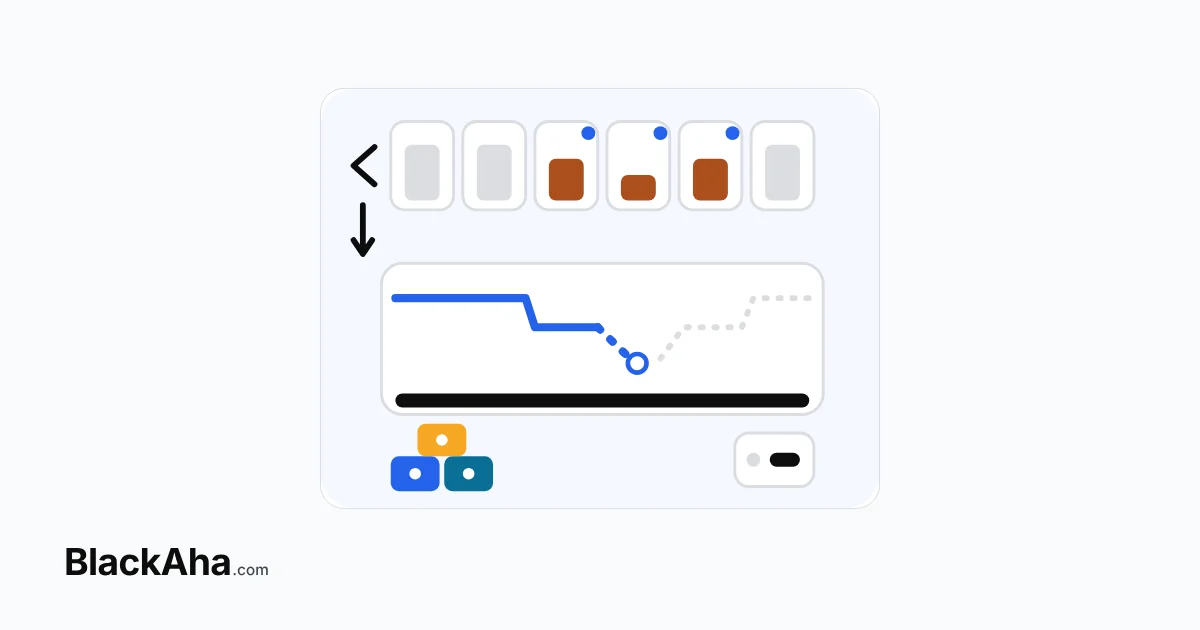
A year end sale season pricing plan starts with last year’s rival price history. Note when each rival cut, how deep and for how long, then set your price steps and floors before the season starts.
Without a plan, you react day by day. A rival drops a price on Monday, you copy it on Tuesday, and by Friday your margin is gone. This guide plans one season for a toy store, using what its main rivals did last November and December.
How do you build a year end sale season pricing plan?
Work in five steps, in this order. Each step uses the answer from the one before.
- Pull last year’s price history for your main rivals.
- Mark each cut: when it started, how deep it went and how long it lasted.
- Elige your own price for each week of the season.
- Set a floor for every product before the season begins.
- Turn it into alerts and rules, then check the plan.
Rivals often repeat their habits, but not always. A rival’s cut is only a surprise if you never looked last year.
What did your rivals do last year?
Abre la pestaña historial de precios of each main rival for your best sellers and look at November and December. Write down three facts per cut: the start, the depth and the length.
Say a toy store sells a building set for $60.00, and two rivals matter most. In this example, last year’s history shows this:
| Rival | Precio regular | Cut price | Depth | Length |
|---|---|---|---|---|
| Rival A | $60.00 | $48.00 | 20% | 5 days, in Black Friday week |
| Rival B | $60.00 | $54.00 | 10% | 3 weeks |
Look at the weeks before a cut too. Some rivals raise prices early, so the “discount” starts from a higher number. See our guide to spotting rivals that raise prices before a discount.
No data from last year? Start now. Our guide to recording what rivals did while it is still fresh makes this season next year’s baseline.
Where should your price go each week?
Answer each rival move with a decision. Follow the cuts your shoppers will see, and ignore the ones they will not. In the example, Rival B’s three-week cut is the one to follow. Rival A’s cut is short, but it lands in Black Friday week, so the plan matches it for those days.
Weeks run from the start of November. W4 holds Black Friday.
| Week | Rival A | Rival B | Your plan | Beneficio/unidad |
|---|---|---|---|---|
| W1 and W2 | $60.00 | $60.00 | $60.00 | $24.00 |
| W3 | $60.00 | $54.00 | $54.00 | $18.00 |
| W4 | $48.00 | $54.00 | $48.00 | $12.00 |
| W5 | $60.00 | $54.00 | $54.00 | $18.00 |
| W6 | $60.00 | $60.00 | $60.00 | $24.00 |
What floor stops a bad sale?
A precio mínimo is the lowest price you will accept. Set it before the season, not in the middle of a sale.
In the example, the unit cost is $36.00 and you need a 20% margin on cost. The floor is $43.20. Rival A’s $48.00 is above it, so you can match and keep $12.00 per unit. At the floor you would keep $7.20.
If a rival went to $40.00, the plan stops at $43.20 and lets that sale go. That is a choice you made calmly in October, not a panic in the middle of a sale.
How do you turn the plan into alerts and rules?
Write the plan as a short table: week, rival to follow, price and floor. Then make sure you hear about moves fast. Price Change Alerts tell you when a tracked rival changes its price.
For products where you trust the plan, a Dynamic Pricing rule can follow the chosen rival and stop at your floor. Keep your most important products on manual review. Smart Price recomputes its recommendations daily, so use it as a second opinion on your steps.
What should you check before the season starts?
- Every rival you follow has a tracked page for your top products.
- Each cut from last year has a start, a depth and a length on paper.
- Every product has a floor above cost plus your margin.
- Alerts reach the people who will act on them.
- You wrote down the day prices go back to normal.
Cómo te ayuda BlackAha
BlackAha.com tracks competitor prices automatically and keeps the price history of every competitor page it tracks, so you can see when and how deep rivals cut. History starts when a page is added, so add your main rivals early. Price Change Alerts reach you by Email, Slack, Telegram, WhatsApp or Lark. Dynamic Pricing rules use guardrails to stop a price at the floor you set.
Ideas clave
- Plan the season from last year’s rival price history: when, how deep and how long.
- Decide your price for each week before the season starts.
- Set a floor above cost plus margin for every product.
- Follow the rivals your shoppers compare you with, not every rival.
- Use alerts and rules to run the plan, and keep key products on manual review.
Preguntas frecuentes
How far back should I look?
Start with last November and December. If you tracked rivals for two seasons, compare them to see whether the pattern repeats.
What if rivals act differently this year?
Treat last year as a first guess. Alerts show the real moves, and your floor protects the margin either way.
Should I match every rival cut?
No. Follow the rivals your shoppers compare you with, and never go below your floor.
What if I have no data from last year?
Start tracking now and record this season. It becomes your baseline for next year.
Pick your five best sellers, mark last year’s cuts and set their floors. Then you can probar BlackAha con tus propios productos.
 English
 ไทย
 Tiếng Việt
 한국어
 日本語
 简体中文
 Français
 Deutsch
 Русский
 Italiano
 Polski
 Español